
Written By
Adrak Hussain
0:00
/
English
0:00
/
اردو
Latin America, which takes its name from the colonial legacy, is generally understood to comprise thirty-three countries in the post-colonial regions of South America, Caribbean islands, and Central America. The area, which has a vast population of 664 million, about 9% of the world as of 2023, is rich in natural resources and home to rising economies. Hence, it is an essential market for trade and economic cooperation. This insight explores Pakistan’s relations with Latin America through the diplomatic, information, military, and economic (DIME) framework. It argues that Latin America has been left untapped due to various challenges despite its growing economic significance.
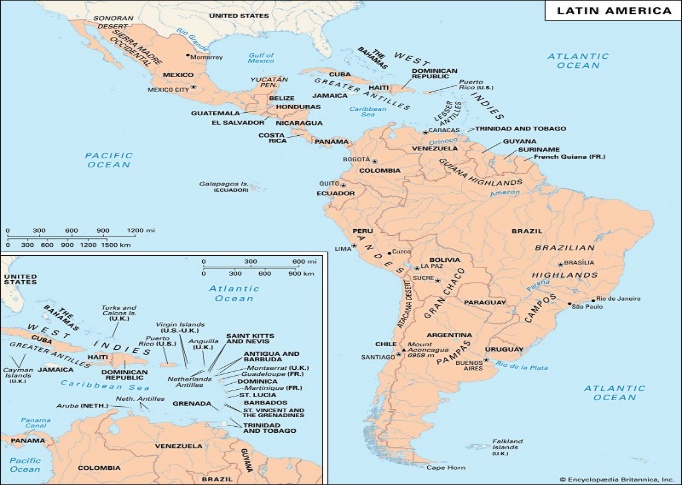
Source:Britannica.com
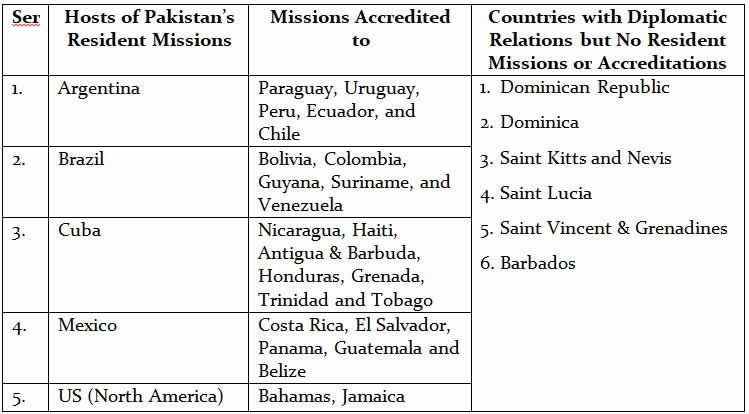
Diplomatically, Pakistan has resident missions in only four countries in the region: Brazil, Argentina, Cuba, and Mexico. These embassies are accredited to twenty-one countries, and Pakistan's US embassy is accredited to two countries in the region, as shown in Table 1. The resident missions are not adequately staffed and lack defence sections, except the mission in Brazil, while the embassy in Cuba lacks a commerce section.
Pakistan signed communiques to establish formal diplomatic relations with six Latin American and Caribbean countries in 2024 on the sidelines of different UN sessions. However, no embassy in the region is accredited to these countries, and diplomatic relations are mainly limited to cooperation in international organizations. High-level visits from Pakistan to Latin America have been limited to Brazil, reflecting weak diplomatic engagement on rare occasions.
Pakistan’s Diplomatic Relations with Latin American Countries
Source:Foreign Ministry of Pakistan and Ministry of Information and Broadcasting
The Pakistani diaspora in the region is only a few thousand and is mainly restricted to Brazil, which hosts around 3000 Pakistanis. Due to this, there is very little cultural exchange between Pakistan and the region.
Similarly, military and defence cooperation is also negligible. However, Pakistan and Brazil signed a Memorandum of Understanding (MoU) in August 2019 and April 2025 on defence cooperation related to developing, producing, and trading defence products on the sidelines of the Latin American Defence and Security Exhibition.
The economic outlook of Latin America shows that its collective GDP was US$6.56 trillion in 2023 and is projected to be $6.72 trillion in the financial year 2024-25, showing a growth of 2.2%. Its average GDP per capita income is around $10,296, with significant variations among countries.
It is home to rising economies like Brazil and Argentina, which are members of the G20. In 2024, imports to the region grew by 3.2% and totalled $1.45 trillion, with machinery, chemicals, electronics, pharmaceuticals, petroleum products, food items, and textiles being the top imported categories. In the same period, its exports grew by 4% and totalled $1.62 trillion, with agricultural products and natural resources, primarily soybeans, coffee, sugar, copper, iron ore, and petroleum as the top exports.
Pakistan’s trade relations with the region are minimal, and it has bilateral trade agreements with only a few countries, including Brazil, Argentina, and Chile. A Framework Agreement on trade, which was under negotiation since 2006, with the MERCOSUR (Mercado Común del Sur)—Southern Common Market, was signed and ratified by the Pakistan cabinet in September 2024.
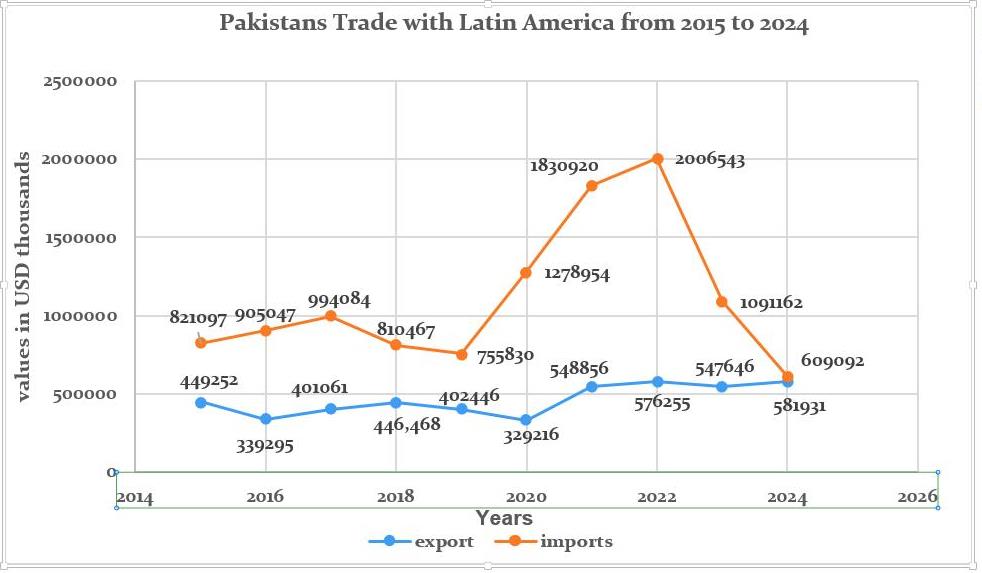
Pakistan’s trade with the region is mainly import-driven, as shown in Graph 1. From 2021 to 2024, the exports improved, coinciding with the COVID-19 pandemic years, during which most industries worldwide reduced their production, but Pakistan’s industries kept running. In 2024, the exports increased slightly to $581.93 million against decreasing imports of $609 million, narrowing the trade deficit.
Graph 1
Source:Self-Compiled
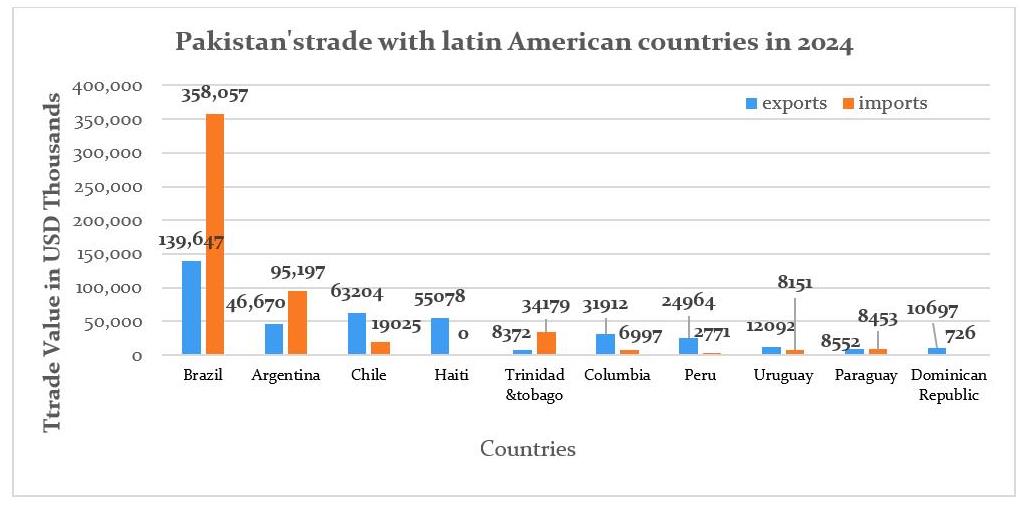
Graph 2 shows Pakistan's trade with Latin American countries in 2024. Pakistan has relatively more trade with countries like Brazil, Argentina, Chile, Haiti, Colombia, Trinidad, and Peru. There is a trade deficit with major trading partners like Brazil and Argentina, although exports to these two are higher than to other countries. The negligible trade with other countries indicates that the region has been unexplored.
Graph 2
Source:Self-Compiled
Pakistan's exports to the region include textiles and apparel, pharmaceuticals, sports items, rice, house linen, leather, rubber tyres, etc. The principal imports include food products, raw cotton, inorganic chemicals, iron, and steel.
Economically, while there are signs of improvement in trade, Pakistan’s engagement with Latin America remains unsatisfactory, narrowly focused, and import-driven. The lack of diversification in export offerings, bureaucratic delays in formalising trade agreements like the PTA or FTA with MERCOSUR, and weakness in aligning with market demands reveal deeper issues in Pakistan’s external economic strategy. This strategic neglect is primarily underscored by a lack of awareness about the Latin American market, leaving it untapped. In the evolving world order characterised by the decline of unipolarity, the emergence of multipolarity, geopolitical competition, and trade wars among major powers such as China and the USA, there is an increasing need for international partnerships to explore new options and reduce dependence on conflicting powers. Hence, Latin America should not remain a missed opportunity but be repositioned as an essential component of Pakistan's market diversification and South-South cooperation agenda. To that end, a “Pivot to Latin America' policy may be required, focusing on developing stronger diplomatic, trade, and defense ties with the region.
To begin with, Pakistan needs to enhance the capabilities of its existing missions and consider establishing additional resident missions, considering the region's geographical conditions and population. The performance of embassy staff must be evaluated by linking them with trade indicators.
Pakistan must improve market awareness through public-private partnerships and diplomatic interaction with regional countries. Export diversification, driven by research-based market knowledge, is necessary. It must focus on areas that bypass the challenges, such as exporting IT and software services and signing preferential trade agreements (PTAs) and free trade agreements (FTAs) without delay. Special attention should be given to enhancing bilateral trade relations with smaller economies.
Frequent visits by high-level government officials must be conducted to establish better relations underpinned by much-needed bilateral and multilateral agreements. Additionally, people-to-people contacts with the region must be expanded through scholarship programs, cultural exchange programs, and other soft-power initiatives, fostering deeper ties and long-term cooperation.
The views expressed in this Insight are of the author(s) alone and do not necessarily reflect the policy of ISSRA/NDU.