
Written By
Ayesha Afgun
Research Associate
ayesha.afgun@gmail.com
0:00
/
English
0:00
/
اردو
This Insight examines Pakistan’s historical connections with African countries and explores how it can build upon these relationships.
Since 1947, Pakistan has supported colonised nations, particularly in Africa, strengthening its diplomatic standing by backing Algeria’s independence, the anti-apartheid struggle in South Africa, Namibia’s liberation, the end of white rule in Rhodesia, etc. Pakistan actively advanced these causes at platforms like the United Nations (UN). Moreover, Pakistan extended extensive moral, diplomatic, financial, and material assistance to countries including Morocco, Tanzania, Kenya, Sudan, Ghana, Libya, Somalia, and Zimbabwe during their freedom movements.
Pakistan was among the first to recognise Algeria’s Provisional Government in 1958, offering diplomatic and
political support during Algeria’s struggle against French colonial rule. It also advocated for Algeria at the UN
and diplomatically, politically, and morally assisted the National Liberation Front.
Pakistan supported Ghana’s independence in 1957, raising the issue of African decolonisation at the UN. It built
strong ties with Ghana and shared a vision of post-colonial cooperation through the Non-Aligned Movement (NAM) and
the Organisation of Islamic Cooperation (OIC).
Pakistan extended diplomatic support to Morocco’s anti-colonial struggle by facilitating its participation at the
UN in 1952. Pakistani passport was issued to the Moroccan envoy, allowing him to speak in favour of his country’s
independence. This symbolic act positioned Pakistan as an early advocate of decolonisation and pan-Islamic
solidarity.
Similarly, Pakistan’s relations with South Africa span nearly six decades. As a staunch supporter of the African
National Congress, Pakistan openly opposed apartheid and racial discrimination in South Africa. It provided
diplomatic support at the UN in 1962 and the OIC in the 1980s to condemn apartheid.
During the late 1950s and early 1960s, Pakistan supported Tanzania’s independence movement through financial
assistance to the Tanganyika African National Union.
Pakistan supported Kenya’s independence in the 1960s by backing the Kenya African National Union through moral and
diplomatic channels. In 1956, Pakistan advocated for Sudan’s independence from British-Egyptian rule at
international forums and subsequently assisted in education, military training, and healthcare. Similarly,
Pakistan recognised the United National Independence Party as the legitimate representative of the Zambians.
Moreover, Pakistan diplomatically supported Uganda’s independence in 1962 and the movement of the Peoples Congress
through financial aid and political backing. Pakistan played a key role in securing Uganda’s representation at the
UN (1960s).
Pakistan has provided military personnel, advisors, and experts to African countries like Egypt, Zimbabwe, and
Sudan, particularly during wartime and post-conflict reconstruction. In the 1970s, Pakistan offered military
training and arms to Libya. After Zimbabwe’s independence in 1980, Pakistan played a key role in restructuring its
air force, with Air Vice Marshal Azim Daudpota of the Pakistan Air Force (PAF) becoming its Commander in 1983.
Pakistan supported liberation movements in Angola, Guinea-Bissau, Libya, Namibia, Rhodesia, and Western Sahara
through political and diplomatic means. It helped exiled leaders return by issuing Pakistani passports. Pakistan
also sent doctors, engineers, judges, teachers, and pilots to train locals across African countries.
Another cornerstone of Pakistan-Africa relations has been Pakistan’s substantial role in UN peacekeeping
operations. Since its first deployment to Congo in 1960, Pakistan has become one of the largest contributors of
troops to UN missions, particularly in Africa.
Over 200,000 Pakistani peacekeepers have served globally, most deployed in African conflict zones like Congo,
Somalia, Eritrea, Liberia, Darfur, Mali, Chad, Burundi, Sierra Leone, and the Central African Republic.
As of February 2025, approximately 2803 Pakistani personnel serve in peacekeeping missions across Africa,
including South Sudan (UNMISS), the Central African Republic (MINUSCA), Western Sahara (MINURSO), Abyei (UNISFA),
and the DRC (MONUSCO), maintaining Pakistan’s position among the top five troop-contributing countries.
Beyond political and military support, Pakistan has contributed to capacity-building across Africa. Pakistan’s
Foreign Service Academy has trained over 775 diplomats from 52 African countries. At the same time, military
officers from Nigeria, Kenya, Tanzania, and Sudan routinely attend training at Pakistani defence institutions,
such as the Pakistan Military Academy, Command and Staff College, and the National Defence University.
Pakistan’s Historic Contributions to African Nations
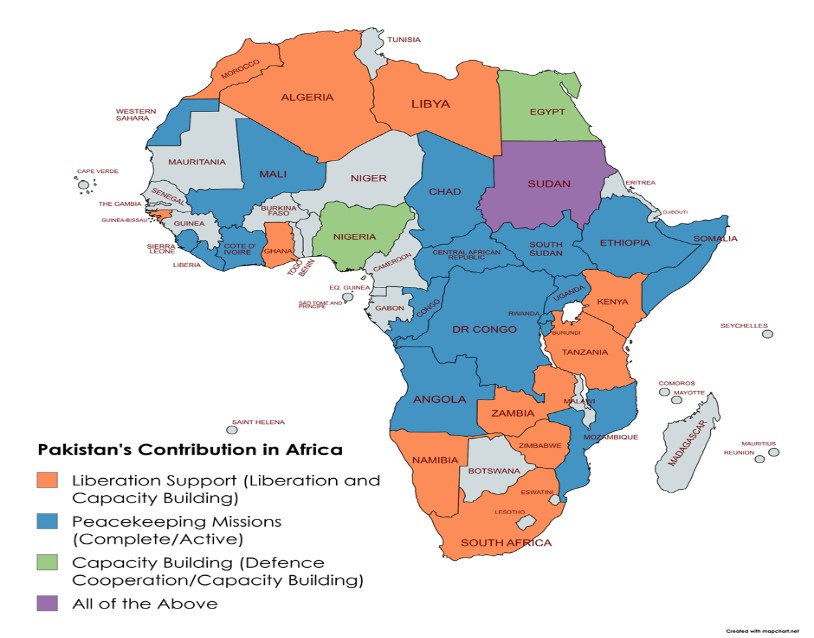
Source: (Compiled by the Author)
Through the Pakistan Technical Assistance Programme, launched in the 1950s and open to 34 African nations,
thousands of scholarships have been awarded to African students, and military personnel from partner countries
have received training.
While Pakistan has a strong historical connection with Africa, its current diplomatic footprint in Africa is
limited. It maintains only 20 embassies and engages in forums such as the African Union (AU), the Organisation of
Islamic Cooperation (OIC), and the UN, but lags behind its competitors. Despite the 2017 "Look Africa Policy"
bilateral trade remains modest, peaking at US$6.34 billion in FY 2021-22 (comprising only 6% of Pakistan’s total
exports) before declining to US$4.44 billion in FY 2022-23. Over the past six years, it has fluctuated between
US$4.18 billion and US$6.34 billion, reflecting limited growth.
To translate historical goodwill into concrete gains, Pakistan must expand its diplomatic presence across Africa,
a 54-nation bloc with an equal number of UN votes and rising strategic weight. Ambassadorial performance should be
assessed through clear key performance indicators (KPIs), especially trade volume growth during their tenure.
Regular reviews ensure accountability, track impact, and guide more effective engagement.
Political engagement must also be revitalised. Pakistan’s last head-of-state visit to Africa was in 2014
(Nigeria). Despite an increase in working-level exchanges, high-level political interactions remain rare. Such
visits, deeply valued in African diplomatic culture, are vital for securing major trade deals and signalling
serious intent, often paving the way for strategic agreements.
Pakistan should also leverage the African Continental Free Trade Area (AfCFTA) to boost trade and deepen ties
through education, technical collaboration, and development initiatives. Pakistan can tap into growing African
markets by targeting low-cost exports, such as defence equipment, pharmaceuticals, machinery, and IT.
Signing trade agreements with regional blocs would facilitate market access under a unified regulatory framework.
Simultaneously, Pakistan must actively pursue bilateral and regional free trade agreements (FTAs) and incentivise
its private sector to capitalise on these emerging opportunities.
Pakistan’s historical ties with Africa offer a strong foundation for building enduring, mutually beneficial trade,
security, and development partnerships. With sustained political will, high-level engagement, and a clear economic
strategy, Pakistan can position itself as a key partner in Africa’s evolving future.
The views expressed in this Insight are of the author(s) alone and do not necessarily reflect the policy of ISSRA/NDU.