The conviction rate is one of the key indicators of a country’s police credibility. While the arrest rate measures the number of individuals apprehended, the conviction rate reflects the number of successful prosecutions that result in convictions. In this context, this Insight compares arrest and conviction rates across Pakistan.
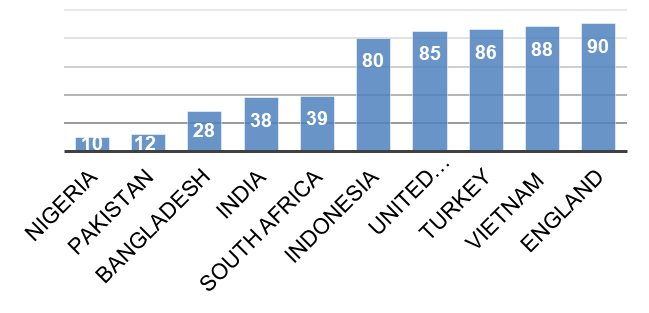
National reports on conviction rates highlight data inconsistencies, with the Pakistan Institute for Legislative Development and Transparency (PILDAT) estimating an 8.66% rate, versus provincial data suggesting a rate of around 12%. Figure 1 illustrates that Pakistan’s conviction rate is alarmingly low compared to other countries. Moreover, Pakistan’s average police-to-population ratio is 1:517, compared to the standard of 1:450 set by the Police Rules.
Figure 1: Conviction Rate (%) - Global Comparison
Source: World Prison Brief
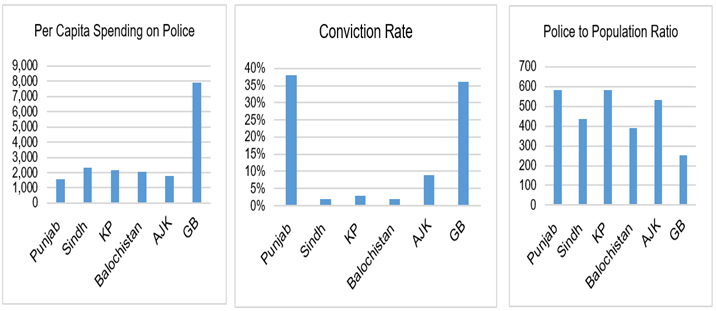
Punjab allocates the largest police budget (Figure 2) and operates 720 police stations covering 53% of Pakistan’s population. Despite a police-to-population ratio of 1:583 and the lowest per capita spending, Punjab achieved a conviction rate of 38% in 2024, with 96,962 convictions out of 256,210 resolved cases.
Sindh’s 555 police stations serve 23% of the country’s population. It has the second-highest per capita police spending and a 1:436 police-to-population ratio. In 2024, Sindh convicted 707 individuals out of 38,372 decided cases, resulting in a conviction rate of approximately 2%.
Figure 2: Policing in Pakistan – A Comparison
Source: Police Reports, and Finance Departments
Khyber Pakhtunkhwa’s 297 police stations cover 17% of the country’s population. Although the per capita spending is relatively high, the police-to-population ratio is similar to that of Punjab. According to the KP Statistics Bureau, only 837 individuals were convicted out of 32,204 cases, resulting in a conviction rate of 3% in 2023.
Balochistan is divided into “A” (police-managed) and “B” (Levies-controlled) areas. Despite a fragmented law enforcement structure, its 130 police/levy stations cover. The country’s 6% population. Its police-to-population ratio is 1:391. According to the Balochistan Police, 2,546 cases were reported, with only 2% resulting in convictions in 2024.
Azad Jammu and Kashmir’s (AJK) 40 police stations are responsible for the region’s 4.5 million residents. The autonomous region’s police-to-population ratio is 1:533. However, according to the AJK Police, 932 individuals were incarcerated in AJK’s prisons, corresponding to 9,962 cases, resulting in a conviction rate of 9% in 2023.
Gilgit-Baltistan (GB) has the highest per capita police spending and Pakistan’s best police-to-population ratio (1:252). The 67 police stations cover a population of 1.49 million. According to the GB government, 18 persons were convicted out of 50 disposed cases, resulting in a conviction rate of 36%, second to Punjab.
Figure 3: Districts Conviction Rate 2024 (%)

Source: Police Reports
District-level data (Figure 3) reveal significant regional variation and a rural-urban divide in conviction rates. For example, despite higher population density, urban areas consistently show higher conviction rates than rural districts.
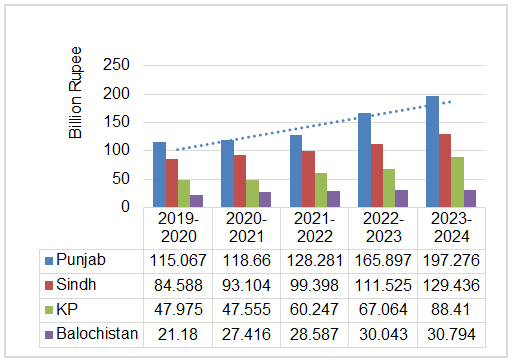
Figure 4: Provinical Police Budget
Source: Provincial Finance Departments
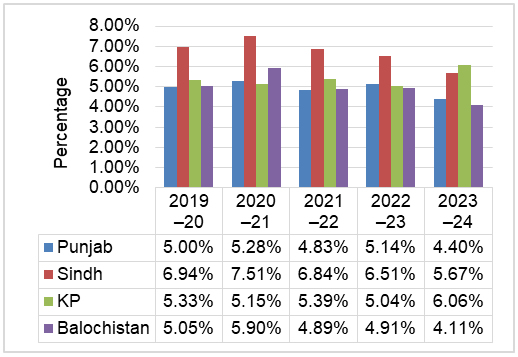
Figure 4 shows the police budget across provinces, and Figure 5 highlights the percentage of each province’s total budget for policing. While police spending has consistently increased over the years, provinces spend 4-6% of their total budget on policing.
Punjab spends the most on police, but its percentage allocation is declining, yet it maintains the highest conviction rate. Sindh allocates the highest percentage, but conviction rates lag spending. KP’s percentage allocation is gradually increasing, but it is not having a positive impact on the conviction rate. Balochistan’s spending remains stable, but its percentage share is decreasing and maintains a low conviction rate.
Figure 5: Budget Share for Policing
Source: Provincial Finance Departments
The analysis reflects a disconnect between police spending and conviction rates. Therefore, simply increasing funds is not the answer. Instead, the police budget should focus on improving the conviction rate. Each province needs to conduct its impact analysis to ensure funds are allocated effectively.
Pakistan Police is functionally divided into investigative and operational branches. Once first information reports (FIRs) are registered, the investigation branch initiates the legal process. It faces distinct yet interrelated challenges, including weak investigations and the filing of fake FIRs.
Punjab established the Punjab Forensic Science Agency (PFSA) in 2012, with fourteen specialised forensic departments. Sindh’s forensic lab is just a DNA testing facility.
Khyber Pakhtunkhwa’s Forensic Science Laboratory, set up in 2017, offers only preliminary forensic support. Balochistan passed the Forensic Science Agency Act in 2015; however, no lab has been established. Consequently, the police of these provinces either rely on outdated methods or depend on Punjab’s forensic lab.
The lack of coordination between police, forensic experts, and prosecutors results in a low conviction rate. Prosecutors often receive incomplete investigation files or those lacking forensic details, making it challenging to construct strong legal arguments. The acquittal rate underscores systemic failures in ensuring substantial, evidence-backed prosecutions.
Police in Pakistan lack specialised investigation training for homicide, cybercrime, and financial crimes. A survey in Karachi found that 86% of police officers had not received forensic training in the past three years, weakening the quality of investigations. An investigation officer in Rawalpindi said that he had not received any new training in the last ten years.
Besides weak investigation, fake FIRs are often used to implicate innocents due to personal enmity, with police misusing arrests as a coercive tool. Likewise, politically motivated FIRs under the maintenance of public order (MPO) and Section 144 also increase the arrest rate. Such cases rarely result in convictions, diverting resources from legitimate investigations and exacerbating the gap between arrests and convictions. Despite the Police Order 2002 imposing penalties for misconduct, systemic issues persist.
Pakistan can enhance conviction rates by addressing institutional challenges through a multi-pronged, province-specific, and impact-driven strategy.
First, enforce the Police Order 2002 to hold police accountable for abuse of power, e.g., fake FIRs, wrongful arrests. Transparency in data accessibility can enhance accountability and enable accurate assessment of policing outcomes. However, political resistance and risks of data manipulation pose challenges. Solutions include establishing independent oversight units and third-party audits.
Second, strengthening institutional capacity is critical. Provincial governments must finance modern forensic infrastructure, treating it as a long-term investment. Although budget constraints are significant, public-private partnerships with universities or private labs, alongside training programmes, offer sustainable solutions. Over time, forensic breakthroughs can deter crime and boost public confidence.
Third, fostering coordination among police, forensic experts, and prosecutors is essential. Standardized protocols and mandatory forensic evidence enhance the quality of prosecutions. While Pakistan’s siloed institutional culture presents a challenge, implementing shared digital platforms for real-time data sharing and inter-agency workshops can bridge these gaps.
Fourth, specialized training is essential for addressing complex financial and cybercrimes. While rapidly advancing technology poses new challenges for investigators, collaborating with global cybersecurity firms for cutting-edge training can help build expertise and stay ahead of the curve.
Pakistan can bridge the gap between arrests and convictions by addressing these systemic issues through stricter oversight, enhanced institutional capacity, and improved coordination.