
Global experience bears witness that Local Governments (LG) have been instrumental in responsive, responsible, and accountable governance for the effective delivery of public services. Paradoxically, Pakistan’s attempts to create space for LGs in its governance structure can best be described as halfhearted.
Thus, it can be conveniently argued that Pakistan’s failure to implement effective LG systems has denied it vital gains in the domains of public service and national harmony. This insight delves into important factors inhibiting the adoption of a dividend-rich LG system, while giving a historical account of its evolution in Pakistan.
LG is premised on the concept of “a governance of a politically delineated specific or local area to include a city, district, town, county, etc”. Sufficient empirical evidence attests to the rationale for decentralised decision-making involving political, administrative, and fiscal devolution of powers (in some cases, legislative powers also) for LGs.
The concept was championed by the UN itself at the UN-Habitat Guidelines on “Decentralisation and the Strengthening of Local Authorities” in April 2007, followed by its Agenda 21 slogan: “think globally, act locally.” It stressed that local actions hold the key to achieving the Sustainable Development Goals (SDGs).
The quality of local governance has taken strides with the incorporation of technological tools (including websites, the Internet of Things (IoT), social media, geographical information systems (GIS), and geospatial data) which promote citizens’ engagement in decision-making and facilitate the managment. Nevertheless, Pakistan stands at 93 out of 162 countries in local governance as per V- Dem 2025 (108 out of 167 in national democracy by Economist Intelligence Unit).
The promulgation of the Basic Democracy Ordinance in 1959, in President Ayub’s era, set the stage for the empowerment of the local/ village representatives in Pakistan. Prime Minister Zulfiqar Ali Bhutto introduced another local body system after the adoption of the 1973 Constitution, but Elections were never held.
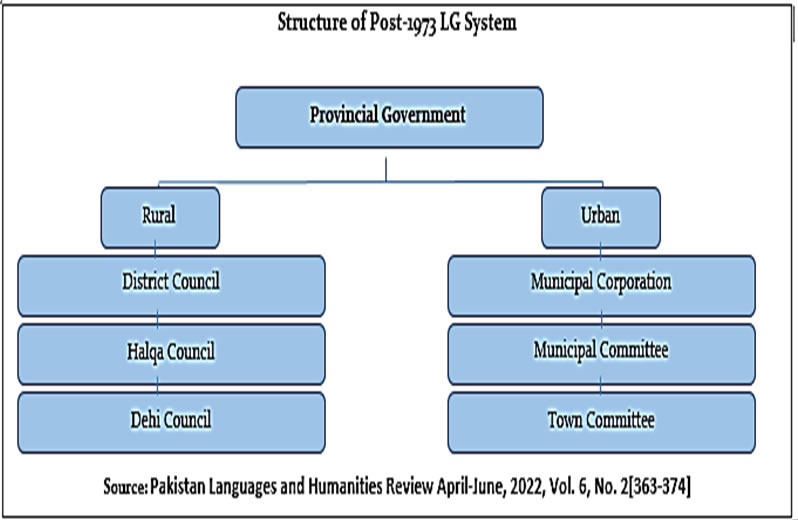
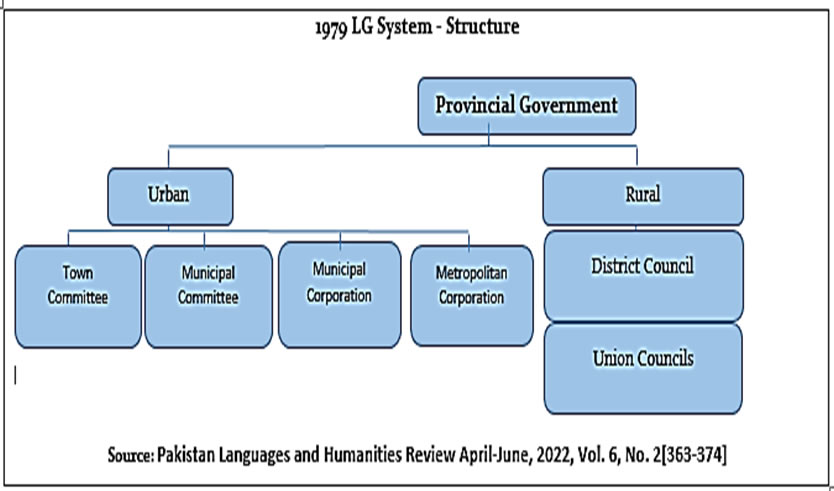
The second practical attempt was made in 1979, with the enactment of the Local Government Ordinance (LGO), which reduced the powers of Bureaucrats in the LGs' management. A variety of functions were also devolved to District councils, including the management of hospitals and schools, construction of public buildings, water supply, roads, bridges, and school buildings.
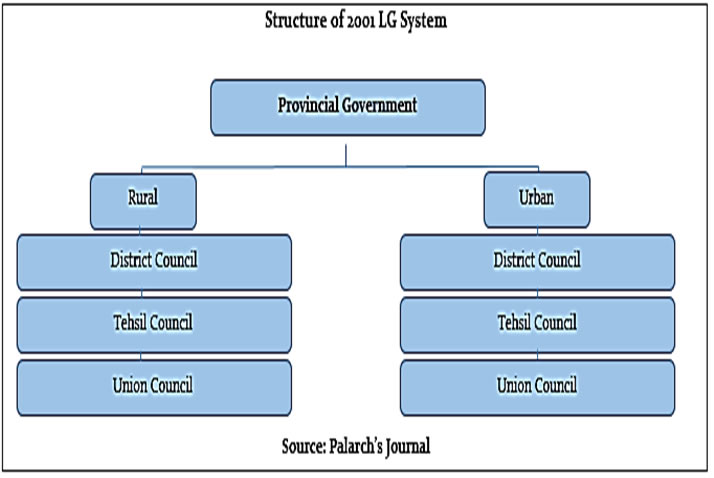
The Year 2000 saw another attempt by then-President General Pervez Musharraf to introduce the LGO 2001, with the distinction of having the same structure for rural and urban areas. The office of Deputy Commissioner was changed to District Coordination Officer, who reported to the elected head of the District Council. Almost all departments were devolved to the District Government except Police, Higher Education, Irrigation, and Water.
The Constitutional guarantee of Article 17 for LGO 2001 expired in 2009, followed by the passage of the 18th Constitutional Amendment in 2010. Provinces (and Islamabad Capital Territory) were mandated to enact LGs as per Article 140 (A) for further devolution. However, slow progress in the passage of Local Government Acts (LGAs) and the establishment of LGs with dubious devolution demonstrates profound reluctance on the part of Provinces to decentralise.
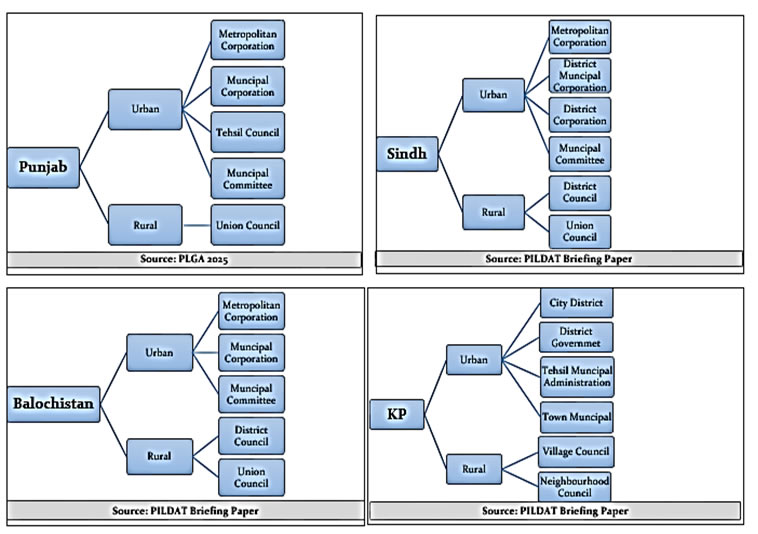
Balochistan was the first province to pass the LGA in 2010, bearing a few similarities with LGO 2001. Punjab and Sindh enacted LGAs in 2013 by adopting many provisions of the LGO 1979. KP also passed its LGA in 2013 with the LGO 2001 as a guide. LGAs vary in LGs’ tenure, with Punjab having a 5-year term, while other Provinces maintain a 4-year term. All provinces have differences in rural and urban governance structures, as shown in the flowcharts below;
All Provincial governments authorized the Local Government Commission functioning under them to remove the LGs, thereby undermining guaranteed tenure. Absence of a constitutionally guaranteed duration renders the LG system highly weak and vulnerable.
The role of bureaucracy is pronounced in the case of Punjab, which assigned DCs the chair of District Authorities on all essential municipal functions as per the recently passed PLGA 2025. It disposes bureaucracy to enjoy authority without public accountability. KP fares better in terms of devolution of administration by enlarging the role of the Chairmen or Mayors in the LGA.
Punjab, Sindh, and KP have formulated Provincial Finance Commissions (PFC) for the transfer of funds, while Balochistan has a Local Councils’ Grant Committee. The role of Provincial Finance Minister as head of PFC and funds sanctioning authority leaves a huge space for influence.
All LGs have been empowered for limited tax collection, which keeps them dependent on Provincial governments for funds.
As regards LG elections, Balochistan held elections in 2013, three years after passing the Act. Its first term ended in 2017–18, yet the next elections and formation of local governments were delayed until 2023, far beyond the legal limit of 120 days.
Punjab, Sindh, and KP held elections in 2015 only under pressure from the courts. After completing their first terms in 2019–20, KP and Sindh postponed elections, which were eventually conducted in 2021–22 and 2022–23, respectively.
Punjab avoided elections entirely and has not had functioning local governments since 2018, citing reasons such as repeated reviews and amendments to the Punjab Local Government Act (PLGA).
Empowerment of LGs is a precondition for effective governance, understood by all political and policy circles. Yet, the inability to enact well-functioning LGs reflects that Pakistan is hostage to deeply entrenched vested political interests and priorities.
Centralisation of political power and the associated benefits of members of provincial assemblies are felt threatened by devolution, especially the development funds, which are essential to build patronage. Maintenance of the status quo is also in the interest of bureaucracy, whose powers are at risk of erosion in the event of the empowerment of LGs. Inadequate training and capacity are other easy excuses for denying the transfer of responsibilities to the LGs. Public participation and community empowerment are purposefully denied to protect the rampant corruption of officials, to prevent the public from gaining rights awareness, and to divert development funds to favoured areas.
Notwithstanding the above, a politically, fiscally, and administratively decentralised LG system is a central pillar for responsive, efficient, and accountable governance. It may not be a panacea for all governance troubles, but surely a people-centric approach and a gateway for the attainment of SDGs. It can also help foster harmony in our ethnically heterogeneous landscape by promoting local ownership.
All Provincial governments bear the responsibility to ensure devolution in the true spirit of “subsidiarity”. In the absence of any political resolve to establish the LG system in Pakistan, it is incumbent upon the judiciary of Pakistan as a constitutional watchdog to ensure compliance by Provinces.