
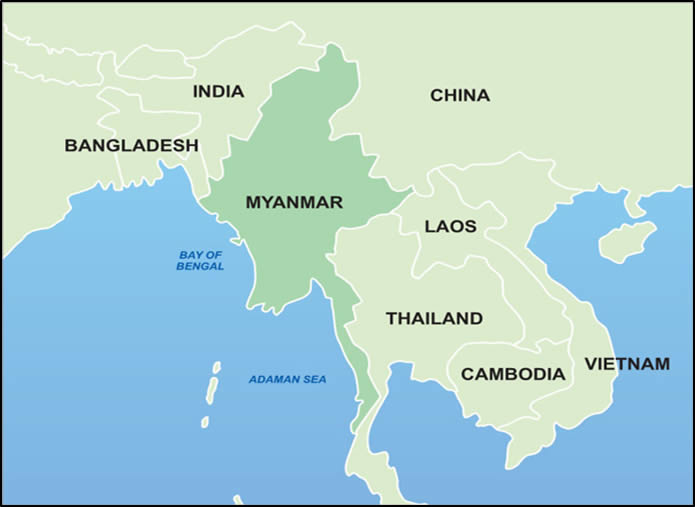
With a 1,930 km coastline on the Bay of Bengal and borders with China, India, Laos, and Thailand, Myanmar lies at the crossroads of South and Southeast Asia. This geographic location gives it substantial value for trade, energy, and regional security, drawing the attention of major powers such as the United States (US) and China. This insight examines how Myanmar’s geostrategic position at the heart of the US-China rivalry has turned it into a contested zone, contributing to domestic tensions and regional instability.
Figure 1:
Source: Reach Myanmar.com
The US and China have opposing approaches towards Myanmar. Beijing, upholding its non-interference principle, has maintained stable diplomatic ties regardless of government changes. Between 2021 and 2025, China held over 70 high-level meetings with Myanmar’s leadership and blocked three United Nations Security Council (UNSC) resolutions targeting the military government.
Economically, China is Myanmar’s most significant partner. This partnership was strengthened after the signing of the China–Myanmar Economic Corridor (CMEC) in 2018, a pivotal element of the Belt and Road Initiative (BRI). In 2025, more than 40% of Myanmar’s total foreign investment is concentrated in projects linked to the CMEC. As demonstrated in (point 1, figure 2), the corridor’s flagship projects include the $2.5 billion Sino-Myanmar oil and gas pipelines, which reduce China’s dependence on the vulnerable Strait of Malacca. Kyaukphyu deep-sea port and Special Economic Zone (SEZ) offers China a maritime gateway for trade and energy transit, with a 70% Chinese stake in the port’s first phase valued at $1.3 billion.
On the other hand, the US has always claimed to support democracy in Myanmar, particularly by providing political backing to Aung San Suu Kyi’s leadership while opposing military rule. After the military coup in 2021, Washington froze approximately $1 billion in Myanmar’s assets held in the US Federal Reserve and imposed targeted sanctions on military leaders and state-owned enterprises. Between 2021 and 2024, the US redirected $317 million in humanitarian aid to multilateral agencies and non-governmental organisations.
In 2022, the Burma Act, a law supporting democracy and humanitarian aid following the 2021 government transition, was passed by the US Congress as part of the National Defence Authorisation Act. It authorised up to $50 million annually for programs supporting democracy, human rights, and humanitarian assistance in Myanmar, further enhancing international accountability mechanisms concerning alleged military abuses. As of 2025, US investment in Myanmar remains limited, with total foreign direct investment under $300 million, concentrated mainly in non-strategic sectors such as services and light manufacturing.
This overview indicates that China and the US pursue distinct models of engagement in Myanmar. China emphasises state-level infrastructure, non-interference and economic integration, while the US engages through aid and support for opposition networks. The US aims to curb China’s regional influence. According to the 2023 Indo-Pacific Strategy Report by the US Department of Defence, Myanmar’s location near China’s Yunnan province is key to limiting China’s unimpeded access to the Indian Ocean and preserving a “free and open Indo-Pacific.”
Figure 2 depicts Myanmar’s areas of control, major troubled spots, and strategic economic routes, including the CMEC. Ethnic conflict in Myanmar increasingly intersects with external strategic interests. Armed clashes between the Arakan Army and government forces intensified in late 2024, displacing over 300,000 civilians in Rakhine State. This region hosts China’s strategic Kyaukphyu Port and Shwe gas pipeline (point 2, figure 2), making it a critical zone for Beijing’s energy security. China has urged de-escalation to protect infrastructure and supply lines, while the US has increased engagement with groups advocating regime change.
In late 2023, the Three Brotherhood Alliance, a coalition of Myanmar’s ethnic armed groups consisting of the Arakan Army, Ta’ang National Liberation Army, and Myanmar National Democratic Alliance Army, launched Operation 1027 (point 3, figure 2), seizing over 150 military posts across Shan and Rakhine States near the China–Myanmar border. The offensive disrupted segments of the CMEC, resulting in a 30% decline in bilateral trade in the first quarter of 2024. China pursued parallel diplomacy with the military and ethnic groups to secure transit zones, while the US welcomed military setbacks and backed an ‘ethnic federal democracy.’
Figure 2:

Source: Adapted from a map published in the New York Times
The Rohingya crisis (point 4, figure 2) has evolved into a geopolitical flashpoint, with nearly one million refugees in Bangladesh as of 2025. Major powers frame the situation differently: the U.S. emphasises the humanitarian crisis, advocating for international accountability, while China resists external intervention, instead supporting Myanmar’s domestic conflict resolution efforts.
Myanmar’s rare earth sector has emerged as another bone of contention between the US and China. Since 2021, China has become the largest importer of Myanmar’s rare earth elements, accounting for resources worth approximately $3.6 billion annually. In late 2024, the Kachin Independence Army seized key mining areas, halting exports and disrupting Chinese supply chains (point 5, Figure 2). India has expanded exploration in Myanmar, aligning with the US-led Indo-Pacific Economic Framework (2022), which seeks to diversify resources away from China.
Myanmar’s internal conflict has generated significant cross-border repercussions. In July 2025, India conducted a drone strike in Myanmar’s Sagaing Region (point 6, figure 2), targeting camps of the United Liberation Front of Assam–Independent, People’s Liberation Army of Manipur, and National Socialist Council of Nagaland–Khaplang.
Thailand continues to face migration pressure, with over 90,000 Myanmar nationals migrating since the 2021 coup. Bangladesh, equipped with US-supplied patrol vessels, MRAPs, and drones, has strengthened border security. Though framed as counter-terrorism tools, analysts note they enhance Dhaka’s capacity to monitor Rakhine insurgencies, enabling Washington to pressure Myanmar and intensify the Rohingya crisis indirectly.
In sum, Myanmar’s geostrategic position has made it a frontline of US-China rivalry, where competing economic, political, and security interests have deepened internal fractures and amplified regional instability.
Pakistan and Myanmar share several strategic similarities, which highlight their importance in regional and global geopolitics. Both possess critical geostrategic locations, lie close to major energy routes, and maintain warm-water ports that connect to the Indian Ocean. They are central to China’s BRI and are treated as strategic focal points in the US Indo-Pacific strategy. At the same time, both face political instability, security challenges, strong military influence, and deep ethnic divisions. In the future, their trajectory will be a critical test case for how strategically located states navigate great power rivalry while striving for stability and sovereignty.