
Every process in human life progresses in a sequence; similarly, the movement towards a logical conclusion is a fundamental principle of order, justice, and understanding human affairs. This insight argues that Pakistan’s fight against terrorism requires bringing every terrorism incident to a logical end, because the lack of a decisive outcome allows terrorists to grow stronger. Reaching a logical conclusion means tracing the chain of events, identifying the perpetrators, and ensuring they are held accountable. Without closure, investigations lose meaning, and the signal to adversaries is one of weakness rather than resolve.
Pakistan’s counter-terrorism efforts reflect years of tough battles against militancy. Compared to Pakistan, the West has not faced terrorism with the same ferocity, but it has taken cases to their logical conclusion. For instance, the US response to the high-profile 9/11 terrorist attack in 2001, activated its entire national security apparatus, established the 9/11 Commission, identified the perpetrators behind the incident, and conducted exhaustive investigations through AUMF (Authorization for Use of Military Force), the Patriot Act, the creation of the Department of Homeland Security (DHS), and the Transportation Security Administration (TSA).
The US also invaded Afghanistan in 2001 to eventually locate and kill Osama bin Laden (leader of Al-Qaeda, accused of the 9/11 attacks) in 2011 through Operation Neptune . This demonstrated a logical conclusion to the incident, reassuring the US public that justice was pursued, accountability was established, and the government’s commitment to counter terrorism was evident.
Similarly, the 2005 London bombings (7/7), carried out by four suicide bombers, prompted immediate and organised reforms: the UK enacted the Terrorism Act 2006, expanded MI5, improved intelligence coordination, and launched the Trauma Response Program to assist survivors. These measures improved institutional readiness, closed investigative and legal gaps, and demonstrated accountability, thereby helping to provide closure and prevent future attacks.
In France, the 2015 Bataclan attack took place at the Bataclan Theatre in Paris, a historic concert hall, whose key suspect, Salah Abdeslam, was arrested in 2016 and later sentenced to life imprisonment. This demonstrated a logical conclusion to the trial, reassuring the public that justice was pursued, accountability was established, and the state’s commitment to counter terrorism was evident.
However, Pakistan has generally not been able to bring terrorism cases to their logical end in the public domain. One such example among many is the Peshawar Police Lines mosque bombing, January 2023, where a suicide bomber disguised as a policeman blasted the bomb during afternoon prayers inside the tightly secured mosque compound.
The initial stages, including immediate response, rescue, and investigation, were completed promptly. In November 2024, a serving constable, Mohammad Wali, was arrested for facilitating the attack and is in judicial custody. Another accused, a juvenile identified as Imtiaz, linked to Jamaat-ul-Ahrar, had his bail plea rejected by the Peshawar High Court in February 2025 due to security concerns and his militant background.
Despite these arrests, more than two years after the tragedy, the case remains unresolved. The judicial process is still in the pre-trial stage, with facilitators on remand and evidence collection underway. At the same time, the prosecution of external masterminds, particularly factions of the Tehreek-i-Taliban Pakistan (TTP) operating from across the Western border, remains pending. This prolonged delay has left justice incomplete, and the cycle has not reached its logical conclusion.
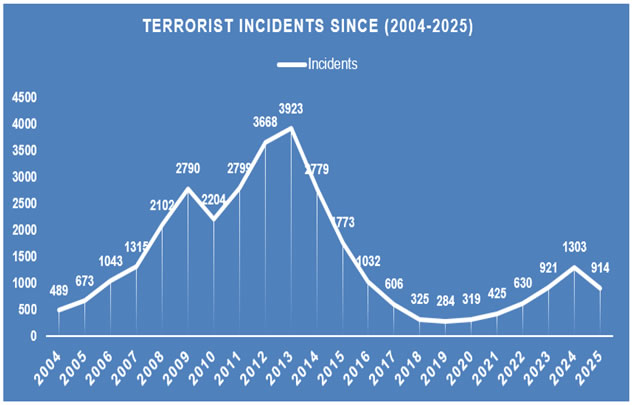
Pakistan has experienced devastating terrorist attacks since 2004, witnessing a peak in 2013–14, followed by a sharp decline in incidents till 2020. However, these terrorist attacks resurged in 2021 following the Taliban takeover in Afghanistan (Figure 1). While these attacks generate national outrage and calls for justice, the aftermath often turns into speculation, incomplete investigations, and unanswered questions.
Figure 1: Terrorist Incidents Since (2004-2025)
Source: Pakistan Security Report 2024, PIPS & SATP
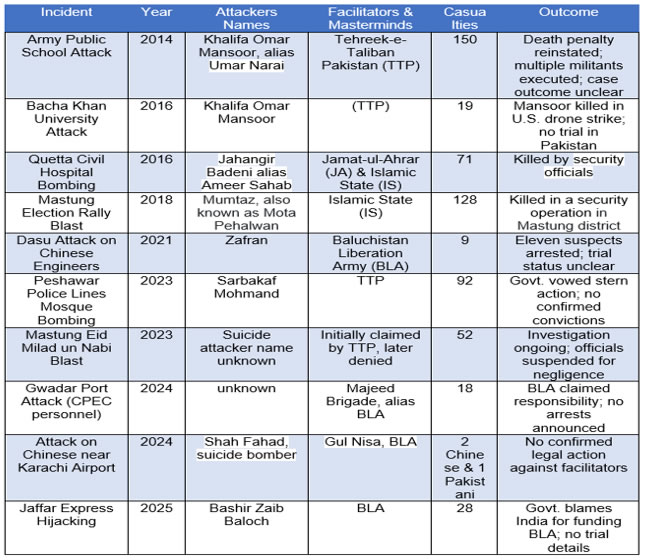
Figure 2: Unresolved High-Profile Terrorism Cases in Pakistan
Source: Compiled and analyzed by the author
Figure 2 highlights High-Profile terrorism incidents in Pakistan since 2014, including the year, the responsible actors, and the open-ended state responses.
Currently, Pakistan has 91 anti-terrorism courts, with 23 located in Punjab, 13 in Khyber Pakhtunkhwa, 32 in Sindh, 9 in Balochistan, 10 in Azad Jammu and Kashmir, 2 in Gilgit-Baltistan, and 2 in Islamabad. According to a 2023 review by NACTA, many terrorism cases are still pending, with Balochistan having the highest share at 34%, followed by Khyber Pakhtunkhwa at 32%, Sindh at 19%, Punjab at 8%, and Gilgit-Baltistan at 7%.
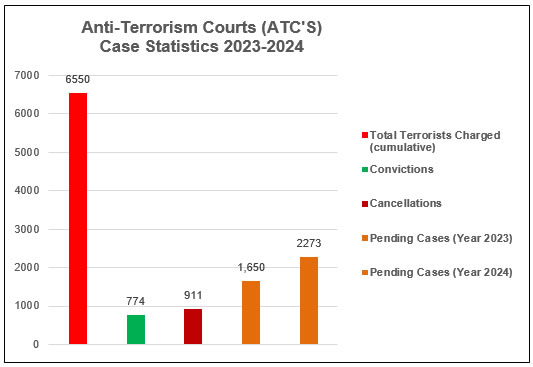
Pakistan’s Anti-Terrorism Courts (ATCs) face deep structural and procedural flaws, with a massive backlog of over 2,273 pending cases (Figure 3). The broad misuse of the Anti-Terrorism Act (ATA, 1997) for common crimes has worsened delays, while conviction rates remain disturbingly low, with 6,550 terrorists charged between 2020 and 2023; out of which only 11% (774) were convicted. Trials are further delayed due to a lack of witness testimonies, insufficient evidence, fear among witnesses, and procedural obstacles, leading to repeated acquittals even in high-profile cases.
Figure 3: Anti-Terrorism Courts (ATCs) Case Statistics 2023-2024
Source: Data compiled via website Minute Mirror
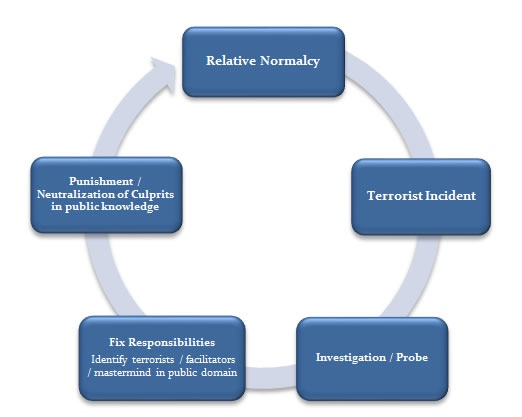
The ongoing failure to resolve terrorism cases affects the credibility of Pakistan’s law enforcement agencies, intelligence services, and even the military institutions that have courageously fought the war against terror. Therefore, to reach logical conclusions in counterterrorism efforts and break the cycle of violence, Pakistan must adopt a strategic and multifaceted approach (Figure 4), drawing from international experiences as models.
Figure 4: A Model to Address Terrorism Incidents towards a Logical End
Source: Illustrated by the author
Pakistan confronts terrorism with an intensity much higher than many other countries. The frequency of attacks is so high that one case rarely concludes before another begins, creating systemic obstacles in providing timely closure and justice. However, at least high-profile cases must reach their logical conclusion in the public domain, to uphold the rule of law, create a strong deterrent against future acts of terror, and to minimize false narratives and propaganda by vested interests.
Similarly, in the case of suicide attacks or when the terrorists are killed by the law enforcement agencies during a fight, the complete identity (family/village/city, etc.) must be disclosed in the public domain.
Pakistan can break the cycle of impunity that fuels terrorism with a resolute approach. Swift court resolutions and effective prosecution in Anti-Terrorism Courts, supported by a reformed police force or National Counter Terrorism Force (NCTF), will reinforce the rule of law. It's equally vital to publicly identify facilitators and masterminds and serve them the justice they deserve. These measures will help Pakistan shift from reactive, and mostly kinetic responses to a strong deterrence framework, ensuring terrorism is met with clear and unavoidable consequences.