
Written By
Sidra Jamil
Research Associate
rasidrajamil@ndu.edu.pk
0:00
/
English
0:00
/
اردو
The Fulbright Scholarship, often hailed as a beacon of academic excellence and international cooperation, has long been a cornerstone of US cultural diplomacy. The scholarship is based on comprehensive financial support from the US that covers all educational and living expenses. Since its inception in 1946, the program has awarded scholarships to over 370,000 individuals across 160 countries, including Pakistan. This insight critically examines the past decade of Fulbright scholarships in Pakistan.
Graph 1

Source: Self-Compiled
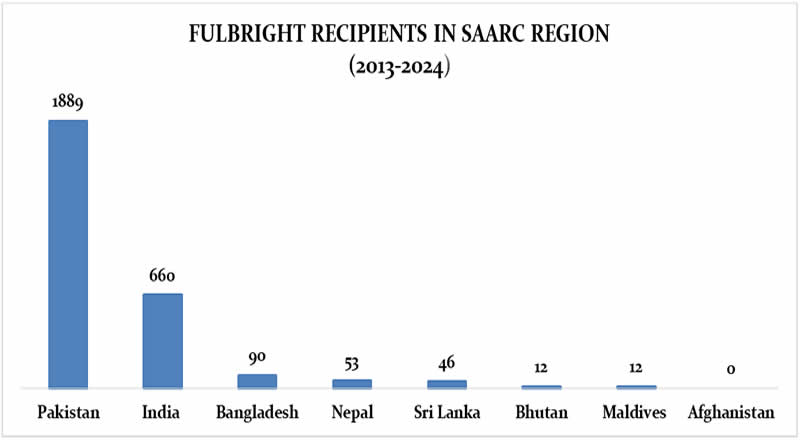
Since its inception in Pakistan in 1951, the Fulbright Program has awarded scholarships to nearly 3,000 Pakistani nationals. In 2022 alone, Pakistan was the largest recipient of Fulbright scholarships globally, with 189 scholarships worth $18.44 million. Graph 2 below indicates that Pakistan has been the largest recipient of Fulbright scholarships in the SAARC region over the last decade.
Graph 2
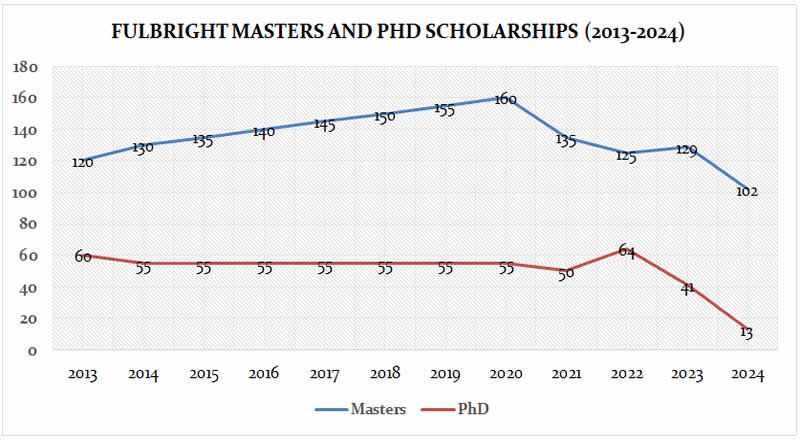
The graph 3 below shows the number of Masters and PhD Fulbright scholarships received by Pakistani nationals in the last decade.
Graph 3
Source: Fulbright Foreign Student Programme
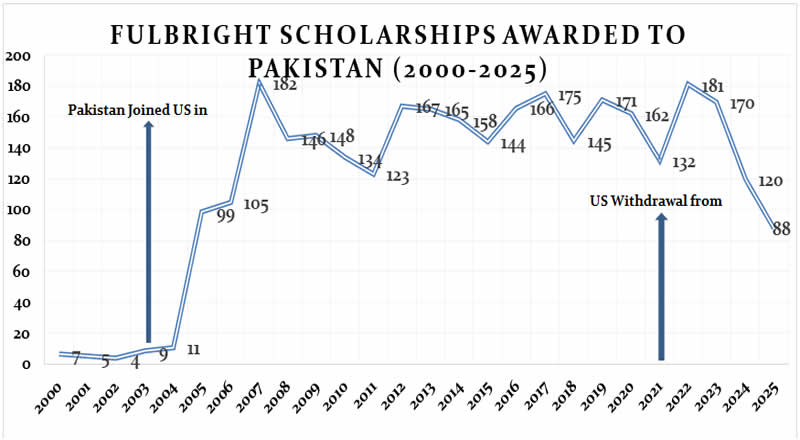
Graph 4 below illustrates the expansion of the Fulbright program in Pakistan, particularly after 9/11.
Graph 4
Source: Self-Compiled
The Fulbright Program operates on a bilateral partnership basis, encompassing the ‘Foreign Student Program’ and
the ‘US Student Program’. The Foreign Student Program brings international graduate students to the US, whereas
the US Student Program allows American citizens to study in partner countries.
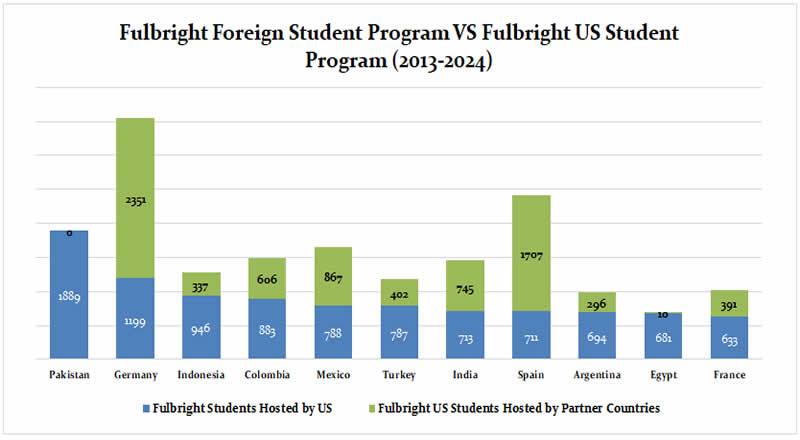
Graph 5 below clearly illustrates that, among the top ten Fulbright recipient countries, every nation except
Pakistan hosts US nationals under the Fulbright U.S. Student Program.
Graph 5
Source: Self-Compiled
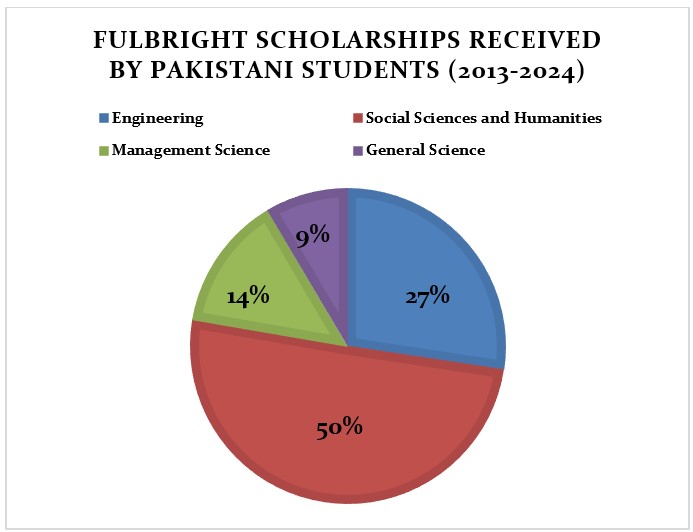
The pie chart below indicates that in the last decade, 64% of Pakistanis secured Fulbright scholarships in Social Sciences, Arts and Humanities, and Management Sciences and only 36% in Engineering and Science subjects.
Pie Chart
Source: Self-Compiled
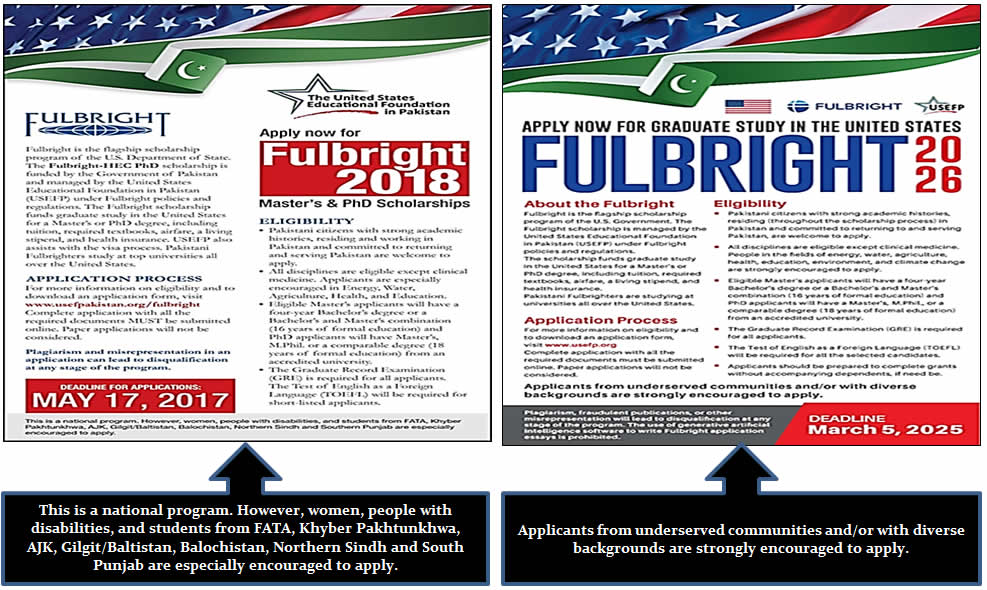
The United States Educational Foundation in Pakistan (USEFP) primarily manages Fulbright selection in Pakistan. USEFP advertisements on its website state that Pakistani citizens with strong academic histories, residing in Pakistan, and committed to returning and serving Pakistan are welcome to apply.
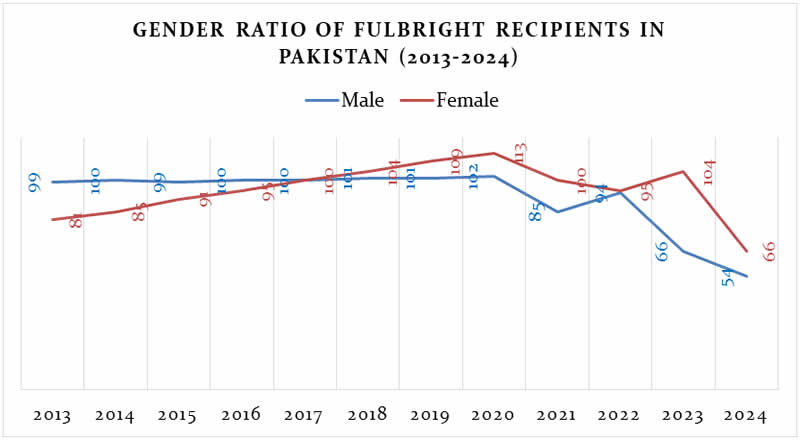
Graph 6 below shows the gender ratio of Fulbright recipients in Pakistan. Until 2018, approximately half of the recipients of the Fulbright Program were women; however, since 2018, the number of female recipients has exceeded that of their male counterparts.
Graph 6
Source: Self-Compiled
The Fulbright Program in Pakistan has contributed significantly to educational exchange and social inclusion by targeting women and individuals from historically marginalized regions such as the former Federally Administered Tribal Areas (FATA), Khyber Pakhtunkhwa, Azad Jammu and Kashmir (AJK), Gilgit-Baltistan, Balochistan, Northern Sindh, and South Punjab. However, the program operates in complex socio-political environments marked by conflict and limited access to state resources, sometimes leading to radicalization. These dynamics underscore the need for ongoing, context-sensitive evaluation. Collaboration among HEC, policymakers, and other stakeholders is vital to sustaining Fulbright’s positive developmental impact.
Some critics believe that returning scholars, having been exposed to Western ideologies and perspectives, introduced views into academic and social spaces that may not always align with Pakistan’s national interests. The tensions observed today, especially among the youth, could be seen not as deliberate efforts to challenge the state but as part of the natural friction accompanying rapid social and intellectual transformation.
Pakistan's unique position in the Fulbright Program, lacking reciprocity in hosting US students, also warrants attention. Pakistan is the only top Fulbright recipient country exempt from hosting US students under the ‘Fulbright US Student Program.’ This absence of two-way exchange limits Pakistan's opportunity to shape its global narrative and foster deeper mutual cultural understanding.
The Higher Education Commission (HEC) of Pakistan does not directly participate in the selection process for Fulbright scholarships, which the US Embassy in Pakistan manages through the USEFP. Furthermore, transparency issues surrounding the Fulbright Program present another significant concern. To obtain data on recipients' demographics, selection, subjects, career paths, and funding details, the researcher visited Pakistan’s HEC, wrote a letter to the US Embassy, and wrote multiple emails to USEFP. Unfortunately, these key institutions have not been forthcoming with such data.
Moreover, the program's disciplinary focus, favoring Social Sciences, Arts, and Humanities over cutting-edge science and technology disciplines, prompts a discussion on its alignment with Pakistan's developmental requirements. In a rapidly evolving world, is the Fulbright Program equipping Pakistan with the skills necessary to compete?
The lack of comprehensive data on Fulbright recipients from Pakistan hinders effective tracking of talent migration, intellectual capital, and potential brain drain. Without accurate records, it becomes difficult to assess how US-educated scholars contribute to national development or otherwise. This limited transparency raises questions about possible foreign influence and the implications for national security.
The Fulbright program should be a two-way exchange, fostering mutual benefit for Pakistan and the US. Enabling Pakistani scholars to study in the US while encouraging American students to engage with Pakistan can enhance cultural understanding, promote knowledge-sharing, and strengthen diplomatic, educational, and economic ties.
HEC should play a more significant role and take proactive measures to safeguard Pakistan's intellectual and cultural autonomy. This includes active participation in the selection process and subject allocation to maintain transparency. HEC should also establish a centralized data bank and monitoring system to track scholarship recipients' demographics, subjects, career paths, and funding details.
Furthermore, a thorough, periodic review of the performance and impact of international scholarships is essential to ensure their relevance and effectiveness. Consistently addressing these factors will help sustain the effectiveness and credibility of such initiatives.
There is a need to review other international scholarships offered to Pakistani nationals, like the Chevening Scholarship (UK government-funded) and the DAAD (Deutscher Akademischer Austauschdienst) Scholarship (German government-funded program), on similar lines.
The views expressed in this Insight are of the author(s) alone and do not necessarily reflect the policy of ISSRA/NDU.