
This Insight explores the contemporary dynamics of Islamophobia while examining the role of socio-political and institutional policies in the West that facilitate the spread of this phenomenon.
The term ‘Islamophobia’ is defined as the fear and hostility toward Muslims or Islam, comprising the discriminatory, exclusionary, and violent practices arising from these attitudes. The notion of Islamophobia became mainstream in global discourse and was employed in academic, legal, and political spheres after the Runnymede Trust report of 1997(UK) ‘Islamophobia: A Challenge for Us All’ marked the first comprehensive study of this issue. It described Islamophobia as an unreasonable aversion to Islam, emphasising its structural and ideological aspects, which undermine freedoms in the political, economic, social, cultural or any other field of public life.
Western societies especially in North America and Europe have experienced rising Islamophobia over the last few decades. The phenomenon is underlined by perspectives rooted in historic colonial encounters, and reinforced by the ‘Clash of Civilisations’ theory, which advanced the characterisation of Islam as a cultural and ideological opponent. The geopolitical conflicts, such as the Iranian Revolution (1979), Gulf Wars, and post-9/11 security discourses, also framed Muslim identities through the lens of terrorism. These perceptions portray Islamic ideology as inherently incompatible with Western liberal values.
The ‘War on Terror’ marked a threshold in positioning of Islam as a global threat. In the aftermath of multiple US/West-driven post 9/11 wars in the Muslim world; refugee inflows from conflict-affected regions deepened fears of cultural displacement. The pronounced discourse on secular-religious tensions aggravated these apprehensions as a result of the influx of Muslim migrants. These fears are also strengthened by conspiracy theory i.e. ‘Great Replacement’, which projects the idea that Muslim migrants are displacing European populations. Moreover, the right-wing populist leaders use these narratives to gain political support in Western societies.
The counterterrorism narratives, largely constructed by the U.S., indirectly institutionalised Islamophobia. These state-driven apprehensions resulted in the national security measures, including mass surveillance, drone attacks, indefinite detention, e.g., Guantanamo Bay, and racial profiling, such as Patriot Act and immigration policies. Consequently, Muslims experience incidents of violence, workplace discrimination, and biased media coverage. Islamophobia continues to be prevalent in the form of the Muslim travel ban and anti-Sharia propaganda, particularly during the Trump administration. In 2024, the Council on American Islamic Relations (CAIR) recorded up to 8,658 anti-Muslim and anti-Arab complaints in the U.S., which is a 7.4% increase, marking highest level since tracking began in 1996.
Figure 1: Muslims in America Facing Religious Discrimination
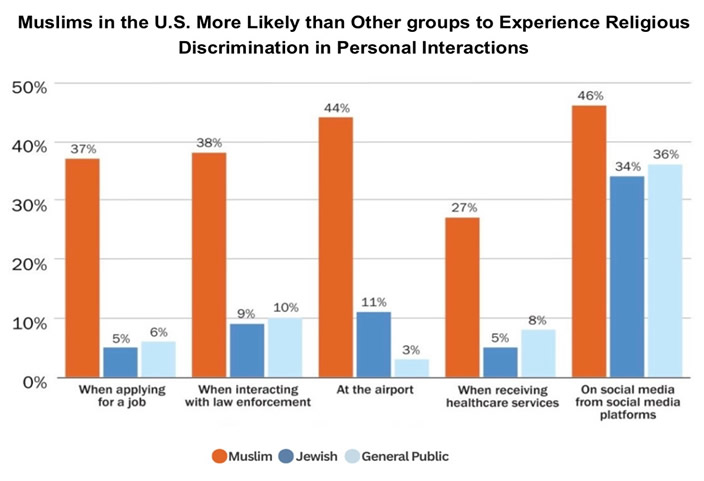
Source: ISPU Islamophobia Index-2022
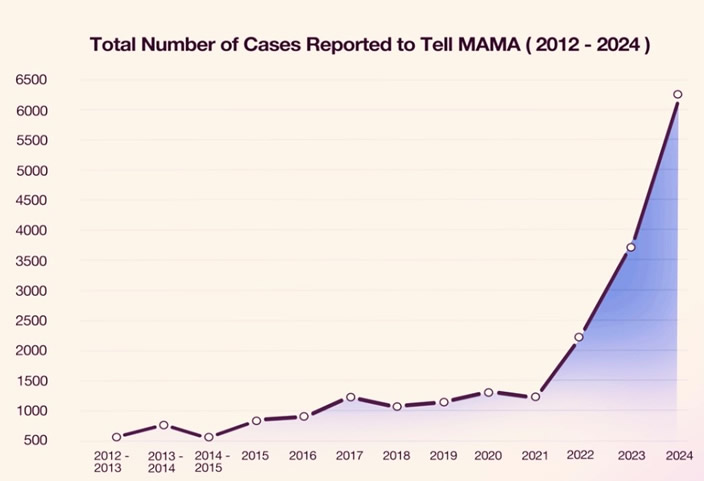
Europe also witnessed a pronounced rise of Islamophobia in the post 9/11 era. Muslim communities have experienced intolerance and socioeconomic marginalisation, leading to psychological trauma and identity crisis. The anti-Islamic incidents are predominantly related to immigration, secularism, and national identity issues. There have been 6,313 anti-Muslim incidents since 2012 in the UK, including a 73% surge in physical assaults in 2024, as Tell MAMA (UK-based Measuring Anti-Muslim Attacks) recorded. This trend became noticeable in post-Brexit and the Prevent program (UK) aimed to fight radicalisation and terrorism.
Figure 2: Number of online and street cases in 2024 Compared to Any Year since Founded in 2011
Similarly, Germany and Scandinavia have seen increased level of far-right movements such as Patriotic Europeans against the Islamisation of the West (PEGIDA) and the Alternative for Germany (AfD), characterising Muslim identity as clashing with that of Europeans. Likewise, France has demonstrated aggressive secularism (laïcité), such as France's National Rally, outlawing headscarves and veils in the name of liberating women. Denmark's ghetto laws also disproportionately feature Muslim-majority immigrant areas, requiring involuntary residential displacement.
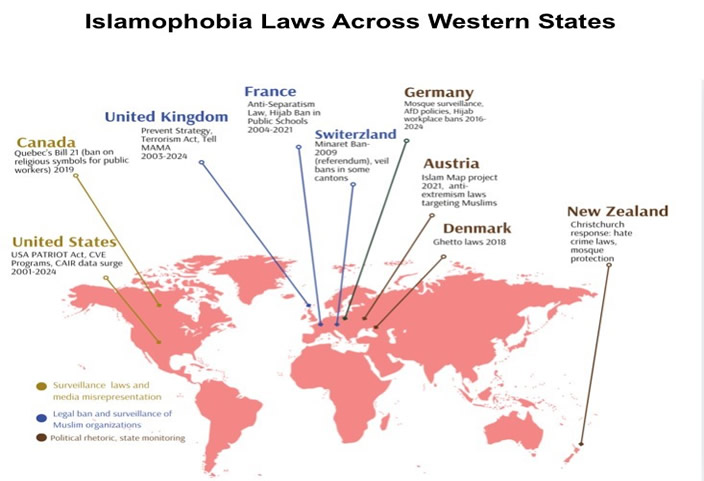
Figure 3: Islamophobic biases embedded in Western legal and policy frameworks
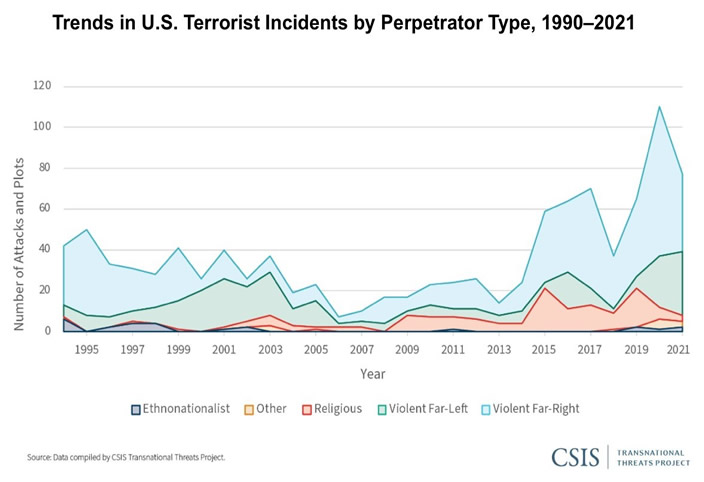
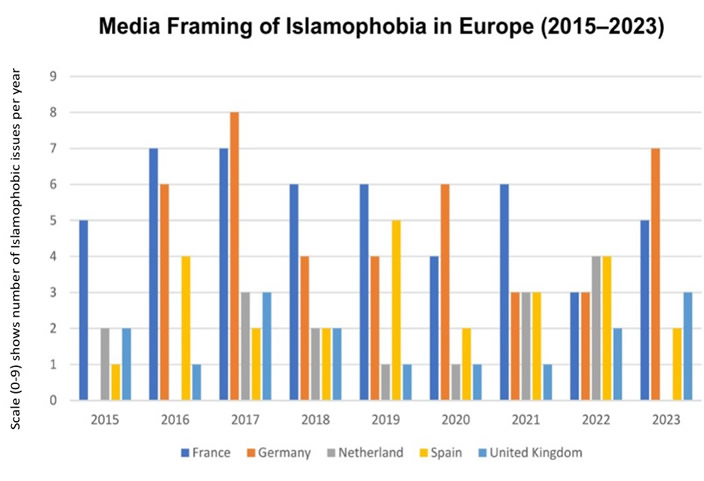
The Western-driven media and information ecosystems promote these socio-cultural insecurities and Xenophobic tendencies. Over 80% of negative media coverage includes explicit or implicit links to Islam, where almost 89% of anti-Muslim hate content reported on social media remained online without surveillance. This political framing collectively blames Muslims, while attacks against them are downplayed as isolated and victim-blaming, obscuring structural Western violence as shown in the graphs below.
Figure 4: Domestic terrorist attacks by perpetrator type in Media coverage (2021)
Source: Self-complied
Figure 5: The graph shows media outlets across European states frame Islamophobia
Western governments acknowledge Islamophobia challenges and have adopted several institutionalised measures. For example, the U.S. Special Envoy and Department of Justice (DOJ) have made efforts to track hate crimes and expanded its Community Relations Service (CRS) to strengthen engagement with Muslim communities. The EU and the Council of Europe have also implemented policy tools and monitoring systems to combat anti-Muslim hatred.
The EU Anti-Racism Action Plan 2020-25, mandated the systematic data collection on hate crimes, establishing over 100 reporting centres for Islamophobic incidents. France also criminalised online hate speech under Avia Law (2020). The media literacy programmes, civil society organisations (CSOs), groups (CAIR) and the Islamophobia Response Unit (IRU), have offered legal and psychosocial support to victims. These responses indicate policy-driven community initiatives to curb discriminatory actions.
Nonetheless, Western reactions to Islamophobia are less effective compared with those addressing antisemitism. For instance, the U.S. has no federal law to address Islamophobia equivalent to Global Antisemitism Review Act (2004). Likewise, 25 EU Member States have endorsed the International Holocaust Remembrance Alliance (IHRA) antisemitism working definition as key reference for national and EU-level counter measures through education, awareness, and law enforcement. Therefore, there is a need for equal legal recognition of Islamophobia and sustained Western efforts to ensure consistent protection and accountability.
It is imperative to comprehend that Islamophobia patterns rely on institutional practices embedded in law, media, and political discourses. The West is trapped in a vicious cycle of fear, surveillance, leading to excessive policymaking. It can be argued that the U.S.-driven framing of ‘Islamic extremism’ has shaped and amplified anti-Muslim sentiments particularly across Europe, which is portrayed as Islamophobia’s epicentre. In reality, Islamophobia is a manufactured construct of the Western political order, normalised and projected globally through interconnected policy and cultural narratives.
In essence, a thorough analysis of the phenomenon suggested that Islamophobia is not the product of instinctive actions or beliefs of Muslims; rather, it is strategically oriented as evident in Western politics distorting security discourses. Responsibility for resolving this problem lies primarily within Western institutions; otherwise, unaddressed Islamophobia would sabotage democratic values and provoke the destabilisation of multicultural societies. Western governments should enforce strong anti-hate laws, monitor media biases, and ensure fair representation to protect Muslim rights of dignity, freedom, and security to strengthen democratic stability.